

Got a passion for pups and wondering if you can actually pay the bills doing what you love? Here’s some good news—dog grooming isn’t just about making tails wag (though that’s definitely a perk). It’s become a seriously viable career path, especially since pet parents are spending more on their furry family members than ever before.
Did you know that Americans spent over $136 billion on their pets in 2022? That’s a lot of pampered pooches needing professional grooming. And honestly, who doesn’t want to work in an industry where your biggest challenge might be convincing a Golden Retriever that bath time isn’t actually torture?
So, how much can you really make as a dog groomer? Well, it’s not a one-size-fits-all answer (kind of like dog collars, actually). Your earning potential depends on a bunch of factors—where you live, how experienced you are, and whether you’re working for someone else or building your own grooming empire.
Let’s dig into the real numbers and what affects them.
Average Dog Groomer Salary in the US
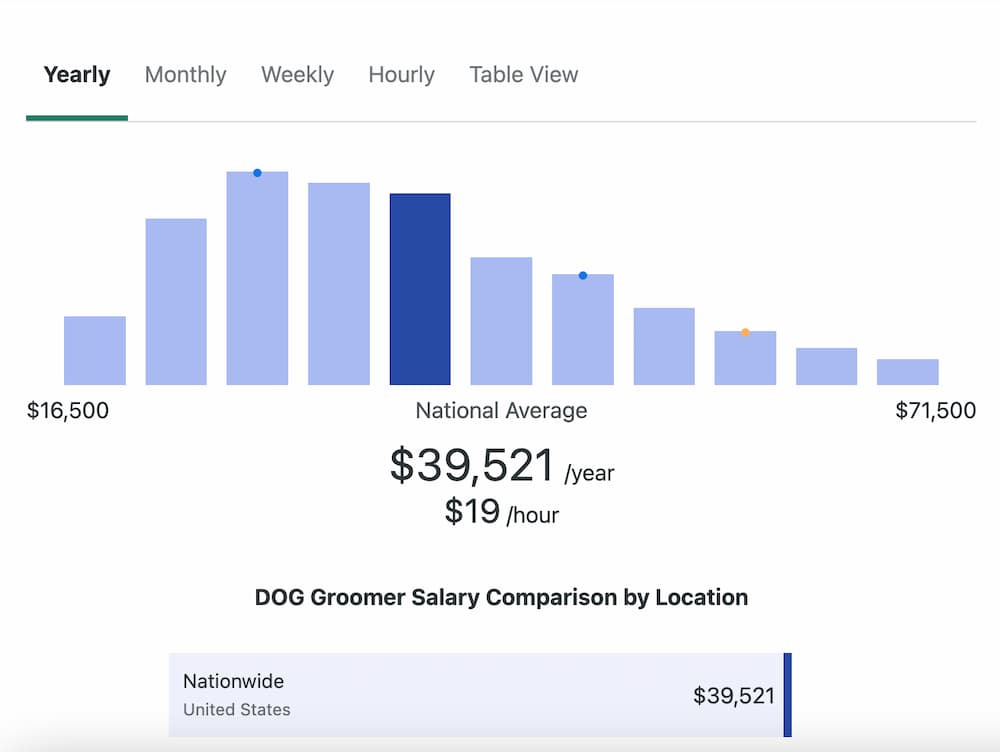
Here’s the deal—dog grooming can absolutely be a career that pays the bills and then some. But like any job, there’s a range. According to ZipRecruiter’s 2023 data, the average dog groomer salary sits around $39,521 per year. Break that down and you’re looking at about $19 an hour, $760 a week, or roughly $3,290 a month.
Not bad for spending your days with four-legged clients who never complain about small talk, right?
But here’s where it gets interesting. The salary range is pretty wide—we’re talking anywhere from $16,500 to $71,500 annually. Most groomers (about 50% of them) fall somewhere between $28,500 and $47,500. That’s a $19,000 swing, which means there’s real room to grow your income as you get better at what you do.
Take location, for example. A groomer in South Dakota might earn around $30,916 yearly, while their counterpart in Texas could be pulling in $44,572. Same scissors, same shampoo, but different paychecks based on where they’re clipping and trimming.
And if you’re thinking about going the entrepreneurial route? Well, that’s where things can really take off. Your earnings become less about hourly wages and more about how many dogs you can make gorgeous—and how much their parents are willing to pay for the privilege.
How A Dog Groomer’s Salary Is Determined
Your dog grooming salary isn’t just pulled out of thin air (unlike the hairballs you’ll inevitably encounter). Several key factors play into what you’ll earn, and understanding them can help you make smarter career moves.
1. Education and Certification:
Look, you might think grooming is just giving dogs a bath and a haircut, but there’s way more to it. Professional training typically takes anywhere from 6 months to 4 years, depending on how deep you want to go. We’re talking breed-specific cuts, handling anxious pups, understanding skin conditions—the works.
Groomers with formal education often start with higher salaries. Makes sense, right? Salon owners would rather hire someone who knows the difference between a puppy cut and a teddy bear trim than someone who learned everything from YouTube videos (no offense to YouTube, but some things need hands-on practice).
That said, you can still break into grooming without formal schooling, but expect to start at the bottom of the pay scale and work your way up.
2. Experience:
Here’s something we see all the time at Hound Therapy: entry-level groomers typically start around $20,000-$23,000 annually. But stick with it for 6-8 years? Now you’ve got leverage to negotiate better wages or even set your own prices if you go independent.
The really seasoned groomers—those with 8+ years and solid reputations—often end up starting their own businesses. At that point, you’re not just earning a groomer’s salary; you’re potentially building a six-figure business (we’ve seen it happen).
3. Your Location:
City dogs generally mean bigger paychecks. Urban pet parents typically have more disposable income and are used to paying premium prices for services. Plus, the cost of living in cities usually means higher wages across the board.
But it’s not just about big city versus small town. Regional preferences matter too. A groomer in an area where tiny breeds are popular might charge more for intricate work on Yorkies and Maltese than someone in a region full of Lab mixes who just need basic baths and brushcuts.
4. The Work Environment:
Your work environment significantly impacts your earning potential. Pet stores, veterinary clinics, grooming salons, mobile services, or your own shop—each comes with different pay structures and earning possibilities.
Mobile groomers often charge premium rates because of the convenience factor (who doesn’t love having their dog pampered in their own driveway?). Groomers who work dog shows can command higher fees for specialized competition cuts. Meanwhile, working for a larger company might mean steadier hours and benefits, but potentially lower per-service earnings.
5. The Pay Structure
Most groomers work on commission—typically earning a percentage of each grooming job they complete. This might be combined with tips from happy pet parents (and trust us, a beautifully groomed Golden Retriever leads to generous tips) or a base salary plus commission.
Working for larger companies often means hourly wages plus benefits like health insurance and paid time off. The trade-off? You might earn less per groom, but you get more stability and perks.
How Much Does It Cost To Become A Groomer?
Getting into dog grooming isn’t like other careers where you need a four-year degree and mountains of student debt. But it’s not free either, and the investment you make upfront can seriously impact your long-term earning potential.
Most certificate and diploma programs run between $3,000 and $6,000. Online programs might be cheaper—around $400 to $600—but you’ll miss out on the hands-on experience that’s crucial for this job. Apprenticeships typically cost about $4,000 but give you real-world experience while you learn.
Some programs include everything you need—textbooks, supplies, even grooming tools. Others require you to buy additional equipment like clippers, specialty shampoos, and brushes. Factor in another few hundred to a thousand dollars for quality tools that’ll last.
The National Dog Groomers Association of America for example provides the necessary information and resources to help aspiring groomers get started in the industry. The organization offers a certification program for those who want to become professional groomers and provides the necessary guidance to make sure you are well-equipped with the right knowledge and skills to excel in your career.
Here’s what some programs actually cost:
- Animal Behavior College: $3,299 to $5,647 (includes hands-on training)
- Penn Foster Career School: $2,000 online with optional certification
- American Grooming Academy: $2,700 complete program, or $900 per level
But here’s the thing about most grooming schools—they teach you technique, but they don’t teach you business. And if you want to make real money in this industry, understanding the business side is crucial.
Hound Therapy Dog Grooming School: The Most Comprehensive Program Available
Right here at Hound Therapy, we do things differently. Our program isn’t just about learning how to groom dogs—it’s about building a successful grooming business. Shannon Griffin, our ISCC champion instructor, believes you can’t become a great groomer by watching videos or reading textbooks. You need real experience with real dogs—including the ones who bite, whine, or try to escape mid-groom.
Because let’s be honest, not every dog is going to sit perfectly still while you work. Some will try to eat your clippers. Others will act like you’re torturing them during a simple nail trim. You need to know how to handle these situations safely and calmly—skills you can only develop with hands-on experience and expert guidance.
But here’s what makes our program special: it’s designed to help you build a six-figure grooming business, not just earn the average groomer salary. Shannon’s already done it herself, and she’ll walk you through every aspect of running a successful operation.

Dog bathing is the first stage of the dog grooming process
The Value of Running a Business
Working for someone else has its perks—steady paychecks, benefits, no business headaches. But if you want to maximize your earning potential, starting your own grooming business is where the real money lives.
As a business owner, you get to choose everything—your location (mobile van, home-based salon, or brick-and-mortar shop), your services, your prices, your hours. We’ve worked with mobile groomers who built six-figure businesses working out of custom grooming vans, traveling to clients who pay premium rates for the convenience.
Others open traditional salons and eventually hire additional groomers, creating multiple income streams while building a local reputation. The key is understanding that once you have the skills and business knowledge, your earning potential shifts from “dog groomer salary” to “successful business owner income.”
Starting a grooming business does require planning and initial capital, but with the right approach, annual earnings can easily surpass $50K and climb toward $100K or more, depending on your client base and service offerings.
Conclusion
Look, dog grooming isn’t just a job—it’s a career where you get to make both dogs and their parents happy every single day. With proper training, business knowledge, and dedication, you can build something that goes way beyond the average salary ranges we’ve talked about.
The pet industry continues growing (seriously, people love their furry family members), which means more opportunities for skilled groomers who understand both the craft and the business side of things.
If you’re ready to explore how Hound Therapy can help you build a successful grooming career—not just learn basic techniques—we’d love to talk. Our program is designed to set you up for long-term success, whether you want to work for the best salons or build your own grooming empire.
Contact us today to learn more about our comprehensive training program, or browse our other pet care services to see how we’re raising the bar in the DFW area.